
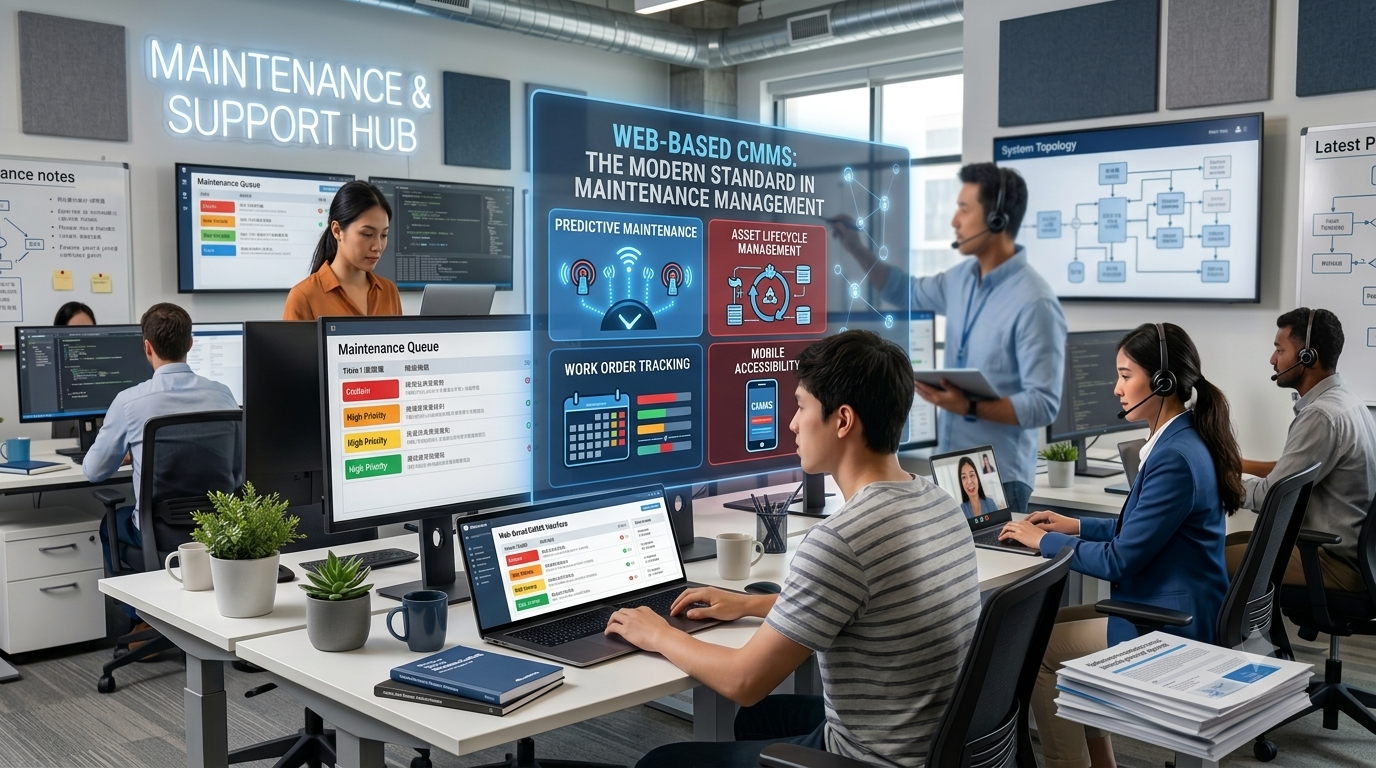
Web-Based CMMS: The Modern Standard in Maintenance Management
In today’s industrial and commercial landscapes, equipment reliability is not just an operational goal—it is a cornerstone of business profitability. A single unscheduled equipment failure can halt production lines, delay customer deliverables, and incur massive emergency repair fees. As organizations strive for leaner, more agile operations, traditional approaches to maintenance management are proving insufficient.
For decades, maintenance teams relied on physical clipboards, spreadsheets, or complex, on-premise legacy software to track their assets. However, the paradigm has shifted. Today, web-based Computerized Maintenance Management System (CMMS) software has emerged as the definitive standard, transforming how modern businesses manage assets, coordinate workflows, and leverage operational data.
Understanding Web-Based CMMS Software
At its core, a CMMS is designed to help organizations schedule, track, and analyze maintenance activities. Traditionally, these systems required local installation on dedicated company servers, demanding significant IT oversight, manual updates, and localized access.
Conversely, a web-based CMMS operates entirely in the cloud. Users access the software through web browsers or dedicated mobile applications. This shift to Software-as-a-Service (SaaS) models eliminates the need for complex internal servers and introduces several key benefits:
Zero Deployment Overhead: No heavy software installation or on-site server configuration is required.
Continuous Updates: Enhancements, security patches, and new features are deployed automatically by the provider without interrupting business operations.
Universal Access: Teams can access critical data from any device with an internet connection, breaking down geographical silos.
Predictable OpEx Costs: Subscription-based pricing replaces massive, upfront capital expenditure with manageable, predictable operational costs.
Why Traditional Maintenance Management Methods Fall Short
To understand the value of web-based solutions, it is essential to look at the limitations of legacy tools:
1. The Scalability Trap of Spreadsheets: While spreadsheets are excellent for simple lists, they fail under the weight of hundreds of assets. They lack automated scheduling, cannot send real-time alerts, and invite human error through manual data entry.
2. The Complexity of Legacy Systems: Early-generation CMMS platforms were notoriously bloated. They often demanded months of specialized training, expensive configuration consultancies, and constant maintenance from internal IT departments.
3. The Information Silo of Paper Logs: Paper work orders and whiteboard schedules offer zero real-time visibility. When historical maintenance data resides in filing cabinets, managers cannot analyze trends or make swift, data-backed decisions.
Modern maintenance management demands speed, simplicity, and agility—qualities inherent to cloud-based architectures.
Key Benefits of Transitioning to a Web-Based CMMS
1. True Mobile Empowerment
Modern maintenance does not happen behind a desk; it occurs on the plant floor, in facilities, and across distributed infrastructure. A web-based CMMS untethers technicians from the office. Through mobile apps, field technicians can:
* Create and update work orders directly from the job site.
* Attach photos of equipment damage or input real-time meter readings.
* Receive push notifications for high-priority or emergency tasks.
This real-time capability dramatically reduces administrative delays and minimizes equipment downtime.
2. Rapid Onboarding and Time-to-Value
Legacy enterprise software projects are notorious for prolonged implementation timelines. Web-based CMMS platforms dismantle this barrier. Designed with intuitive, user-friendly interfaces, these systems allow organizations to get up and running in days rather than months. Technicians can adopt the system with minimal training, resulting in immediate user adoption and a much faster return on investment (ROI).
3. Seamless, Real-Time Collaboration
Maintenance departments must work in tandem with operations, procurement, and external contractors. Cloud-based systems act as a single source of truth. When a technician updates a work order, managers instantly see the status change. If a critical spare part is used, the inventory levels adjust in real time, alerting purchasing agents to restock. This seamless communication eliminates double-handling of data and keeps all stakeholders aligned.
4. Data-Driven Insights and Predictive Action
By consolidating asset data into a centralized cloud database, businesses unlock powerful analytical capabilities. Web-based CMMS software automatically tracks key metrics, including Mean Time Between Failures (MTBF), Mean Time to Repair (MTTR), and overall preventive maintenance compliance. Instead of waiting for a machine to break down, managers can analyze historical trends to predict failures and schedule preventive maintenance during planned operational windows.
5. Scalability Without Friction
As organizations grow, their maintenance needs evolve. A modular web-based CMMS allows companies to start small—perhaps only tracking asset locations and work orders—and scale over time. Features such as spare parts inventory tracking, purchasing workflows, and labor hour integrations can be enabled as organizational maturity grows, avoiding the costs and confusion of bloated, unnecessary features early on.
Real-World Application: Traditional vs. Modern Workflows
To illustrate the impact, consider two different responses to a critical equipment failure:
The Traditional Approach: A critical conveyor belt breaks down. The operator leaves their station to find a supervisor, who writes down the issue on a paper slip. This slip is placed in a physical inbox for the maintenance manager, who reviews it hours later. The manager assigns a technician, who must walk back to the office, retrieve the slip, locate the physical equipment manual, and search the warehouse for spare parts—only to find the required component is out of stock. Production halts for days while parts are ordered.
The Web-Based CMMS Approach: The same conveyor belt breaks. The operator scans a QR code on the machine with their tablet, logging a breakdown request instantly. The maintenance manager receives a push notification and assigns the task to a nearby technician. The technician views the work order on their mobile device, sees the required parts list, confirms stock availability in real time, and reviews past repair logs on-site. The machine is repaired and back online within the hour.
Embracing the Future of Maintenance Management
Transitioning to a web-based CMMS is no longer just a trend; it is a strategic business decision. By centralizing operations in the cloud, organizations shift from reactive damage control to proactive, predictive asset management. The result is minimized downtime, extended asset lifecycles, and a safer, more productive work environment.