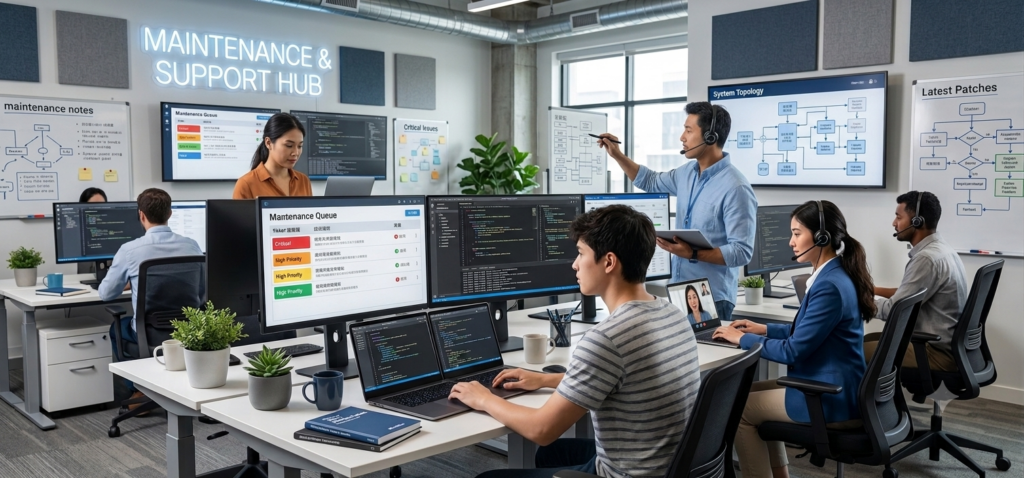

For many businesses and software engineering teams, the day a new software application goes live is celebrated as the ultimate milestone. Teams pop champagne, stakeholders breathe a sigh of relief, and project managers mark tasks as complete. However, treating a software launch as a finish line is one of the most perilous strategic errors a company can make.
In reality, launch day is only the beginning of a digital product’s true operational lifecycle. The moment real users begin interacting with a platform, they bring unpredictable behaviors, diverse hardware environments, varying network speeds, and evolving security demands. Without a structured framework for Post-Development Support: Even the most beautifully designed application can rapidly deteriorate.
To build long-term value, software development companies must view post-launch maintenance not as an optional luxury, but as a core pillar of product viability. This educational guide explores why continuous support is vital to preserving system performance, ensuring runtime stability, and protecting the financial investment of the build.
Defining Post-Development Support: What Happens After Go-Live?
To understand why post-launch care is so critical, we must first unpack what it actually involves. Post-development support is a structured, proactive framework of engineering practices designed to keep a software product secure, efficient, and aligned with user expectations after deployment. It is not merely a reactive “helpdesk” for occasional bug fixing; it is a holistic methodology that spans several distinct categories of software engineering:
1. Corrective Maintenance (Bug Fixing): No matter how rigorous a QA process is, edge cases will emerge in production. Users might attempt unexpected workflows, input invalid data formats, or use niche device configurations. Corrective maintenance identifies, prioritizes, and patches these runtime anomalies before they affect the broader user base.
2. Adaptive Maintenance (Compatibility Updates): Software does not exist in a vacuum. It relies on operating systems (like iOS, Android, Windows, or macOS), web browsers, and third-party APIs (such as payment gateways, mapping services, or SMS notifications). When these external dependencies update, the software must adapt to prevent broken integrations.
3. Perfective Maintenance (Performance Tuning): As database records grow from hundreds to millions, queries that once ran in milliseconds can slow to a crawl. Perfective maintenance focuses on database indexing, API optimization, code refactoring, and caching strategies to ensure speed does not degrade over time.
4. Preventive Maintenance (Security and Infrastructure): This involves regularly updating open-source libraries, applying security patches, auditing access controls, and rotating cryptographic keys to prevent data breaches and maintain compliance.
The Critical Link Between Support, Performance, and Stability
The ultimate goal of any digital product is to deliver a seamless, uninterrupted user experience. This experience is directly governed by two fundamental engineering metrics: performance and stability.
Preserving Performance Under Scale
When an application is tested in a staging environment, it is typically subjected to simulated, predictable user traffic. However, real-world deployment introduces variable concurrent user loads.
Without continuous performance monitoring, a sudden surge in traffic—such as a flash sale, a marketing push, or a viral social media mention—can cause severe resource bottlenecks. CPU utilization spikes, RAM saturates, and database connection pools become exhausted. A dedicated post-development support team implements auto-scaling rules, configures load balancers, and optimizes database queries to ensure that page load speeds and API response times remain fast, regardless of current traffic volume.
Ensuring Runtime Stability Across Ecosystems
System stability refers to an application’s ability to remain functional without crashing, freezing, or exhibiting unpredictable behavior under normal and heavy loads. In the modern tech ecosystem, maintaining stability is a moving target.
For example, Apple and Google release major updates to iOS and Android annually, alongside dozens of minor security patches. A mobile application that is stable on iOS 17 might suffer severe memory leaks or UI clipping on iOS 18. Similarly, web browsers frequently deprecate older JavaScript standards or change cookie tracking policies. Continuous post-development support provides the routine testing and patching required to keep software running stably across an ever-shifting landscape of devices and platforms.
The True Cost of Neglecting Post-Launch Support
Some businesses view post-development support as an unnecessary overhead cost. This perspective is a classic example of false economy. When organizations fail to allocate budget and resources for ongoing maintenance, they incur significant, compounding liabilities known as technical debt.
1. The High Price of “Emergency” Fixes
When software is left unmonitored, issues are often only discovered when a critical system failure occurs. By the time a business notices that a payment gateway is failing or a database has locked up, the damage is already done.
Resolving an emergency outage is far more expensive than routine support. It requires pulling senior developers off other revenue-generating projects, rushing QA processes, and paying premium emergency rates to external consultants. Because these fixes are completed under intense pressure, they are often “quick-and-dirty” patches that introduce further instability into the codebase, creating a vicious cycle of failure.
2. Rising Security and Compliance Vulnerabilities
Modern software is built using web frameworks, libraries, and third-party dependencies. Over time, security researchers identify vulnerabilities in these open-source packages, listing them as Common Vulnerabilities and Exposures (CVEs).
If your software is not actively maintained, these unpatched dependencies become easy entry points for malicious actors. A security breach not only risks devastating data theft but can also result in catastrophic legal penalties under frameworks like GDPR, CCPA, or regional personal data protection acts. Regular security patching as part of an active support agreement is the single most effective defense against modern cyber threats.
3. Brand Degradation and Churn
In a highly competitive digital marketplace, users have very little patience for buggy, sluggish, or unstable applications. If an app crashes during checkout, or a SaaS dashboard takes thirty seconds to load, users will quickly migrate to a competitor.
Negative reviews on the Apple App Store, Google Play Store, or public forums like Trustpilot act as permanent digital scars. Once a product gains a reputation for poor performance and low stability, customer acquisition costs skyrocket, and customer lifetime value plummets.
Best Practices: How to Structure an Effective Support Agreement
For software development companies and their clients, establishing a robust framework for post-development support is a collaborative process. It requires moving away from ad-hoc communication and toward structured, SLA-driven agreements.
Establish Clear Service Level Agreements (SLAs): An SLA defines the expectations for support delivery. It should outline response times based on incident severity. For example, a Severity 1 issue (e.g., complete system outage) might require an engineering response within 30 minutes, whereas a Severity 4 issue (e.g., minor UI misalignment) might have a resolution target of 5 business days.
Implement Proactive Real-Time Monitoring: Don’t wait for users to report bugs. Teams should utilize application performance monitoring (APM) tools like Sentry, Datadog, or New Relic to track errors, latency, and system health in real-time. This allows support engineers to diagnose and patch memory leaks or slow database queries before they degrade the end-user experience.
Adopt a Scheduled Release Cadence: Rather than pushing micro-fixes to production the second they are written, support teams should establish a structured release cadence (e.g., bi-weekly or monthly updates). This ensures that all code goes through a standardized regression testing and staging deployment pipeline, minimizing the risk of introducing new bugs to production.
Designate a Dedicated Support Desk: Post-launch care requires a different mindset than greenfield development. While product developers focus on building new features, a dedicated support team focuses on triage, system architecture, and defensive programming. Keeping these responsibilities distinct prevents context-switching and ensures both initiatives get the attention they deserve.
Conclusion: Software as a Living Digital Asset
Software is not a physical monument carved from stone; it is a living, breathing digital asset. Just as a physical office building requires continuous climate control, plumbing maintenance, and security monitoring to remain habitable, custom software requires continuous **Post-Development Support** to remain functional.
By prioritizing performance optimizations, proactively safeguarding security, and systematically addressing stability issues, software development companies protect their clients’ initial capital investments while building products that scale gracefully over time. In the modern digital economy, the companies that thrive are not those that merely build and launch, but those that commit to the continuous journey of maintenance, refinement, and support.