
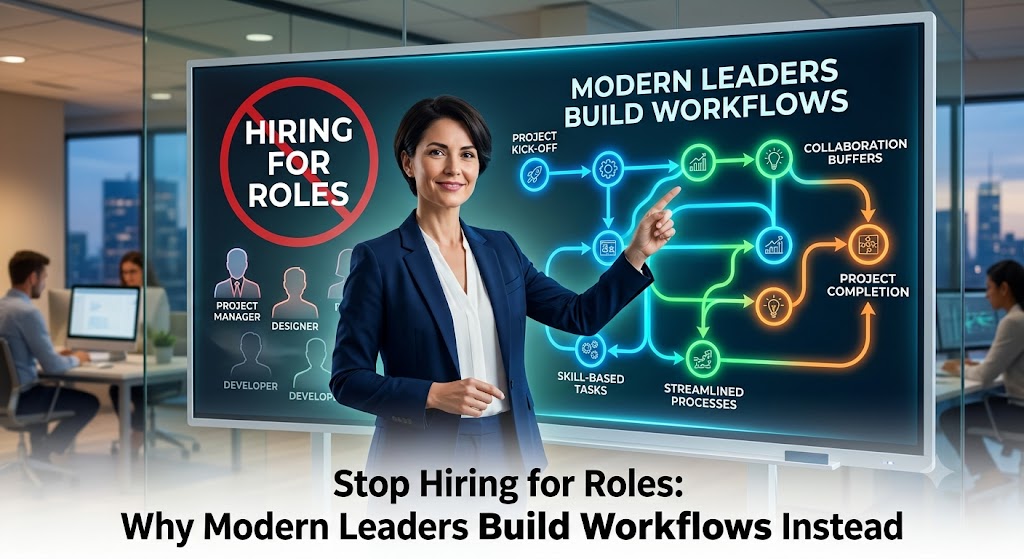
Stop Hiring for Roles: Why Modern Leaders Build Workflows Instead
The most expensive question in business today is not whether your organization should adopt artificial intelligence. It is far more fundamental: “Do we need to hire for this role, or do we need to build this workflow?”
For decades, the default organizational reflex to an increased workload has been to open a new headcount. When the marketing team fell behind, you hired an assistant. When maintenance requests piled up, you hired another scheduler. This instinct made sense when coordinating human labor was the only viable way to scale output. Today, that assumption is not only obsolete—it is a competitive liability.
To thrive in an era defined by rapid technological shifts, organizations must stop thinking in legacy job titles and start thinking in dynamic workflows. By deconstructing roles into discrete tasks, integrating advanced automation, and leveraging intelligent software, forward-thinking leaders are unlocking unprecedented operational leverage.
The Anatomy of a Role vs. a Workflow
A job title is rarely a single, cohesive function. Instead, it is a bundle of distinct tasks. Underneath the title of “Regulatory Affairs Associate” or “Operations Manager” lies a mix of deep human judgment, pattern-matching, routine data entry, and administrative coordination.
When you view your organization through the lens of roles, your only scaling mechanism is adding more people. When you view it through the lens of workflows, you can isolate which tasks require human intuition and which can be executed by automated systems.
Before writing your next job description, decompose the target role into its core components. For each task, ask yourself:
- Does this require unique human creativity or empathy?
- Can this be fully handled by an AI workflow?
- Can this be executed by an AI workflow under human supervision?
Most administrative overhead, reporting, and scheduling fall squarely into the latter two categories.
Case in Point: Operational Efficiency and the Modern CMMS
To understand what this shift looks like in practice, look no further than physical operations and facilities management. Historically, managing a large-scale facility required a small army of coordinators to route work orders, track spare parts, and schedule preventive maintenance. When downtime increased, leaders assumed they needed more administrative staff to manage the chaos.
Today, smart organizations don’t hire more schedulers; they build a superior workflow using an intelligent CMMS (Computerized Maintenance Management System). By integrating AI and automation directly into the CMMS, the software automatically triages incoming maintenance tickets, predicts spare parts requirements, and schedules technicians based on proximity and skill set.
The CMMS becomes the engine of the workflow, eliminating the manual coordination overhead that used to justify three full-time roles. The human elements—actual hands-on repair and high-level capital planning—remain, but the connective tissue of the department is entirely automated. This same structural redesign is currently playing out across every white-collar and blue-collar industry globally.
Capturing the “Margin Window”
Designing your business around workflows rather than headcount isn’t just an efficiency play—it represents a massive macroeconomic opportunity.
When the cost of producing an output drops dramatically due to AI and automation, market pricing does not adjust overnight. Customers remain anchored to what they historically paid for a service. If a specialized agency can now generate a comprehensive regulatory gap analysis in minutes instead of weeks using automated workflows, the perceived value of that analysis remains high, while the internal cost to produce it plummets to near zero.
This discrepancy creates a temporary but highly lucrative “margin window.” Organizations that restructure their operations around workflows today can capture extraordinary profits while market pricing remains anchored to old, labor-heavy cost structures. This window will eventually close as competitors catch up, but the companies that optimize early will establish a financial moat that is difficult to disrupt.
The Hard Truth: Dealing with “Hollowed-Out” Roles
Transitioning from roles to workflows requires leaders to confront an uncomfortable reality. When you successfully automate 60% to 70% of a traditional role, you are left with a “hollowed-out” position.
Too many executives take the path of least resistance: they keep employees in these hollowed-out roles, letting them remain nominally busy with minor tasks. This is a quiet disaster. It creates organizational drag, inflates operating costs, and stalls the professional growth of your staff, leaving them unprepared for an automated future.
The more responsible, compassionate, and economically viable approach is to be radically transparent. Redefine the standards of performance. If AI and automation handle the tedious administrative tasks of a role, challenge your team to reallocate their time toward high-value activities—such as strategic problem-solving, deepening client relationships, or optimizing the automated workflows themselves.
Clarity is kinder than ambiguity. Employees who learn to leverage AI as a force multiplier will become the most valuable assets in your organization. Those who resist must be transitioned out, or they risk a slow slide into career irrelevance.
Build Your Future, One Workflow at a Time
Scaling a business no longer requires scaling your headcount. Before you post your next job opening, pause and examine the underlying system. Don’t look for a person to fit a legacy box on your organizational chart. Instead, design a highly efficient, automated workflow, and then hire the strategic minds needed to steer it.